No products in the basket.
Free delivery for orders over R1000
There is something beautifully poetic about the phrase “pearly whites.”
For centuries, we have used those words to describe bright, healthy-looking teeth — smooth, luminous, clean and strong. And while pearls and teeth are not the same, they do share something fascinating: both are deeply connected to mineral structure, especially calcium-based compounds.
This is where the relationship between Pearl Powder and oral health begins.
Pearl Powder has been used for centuries in traditional beauty and wellness practices, especially in Chinese and Ayurvedic traditions. It has long been treasured for skin luminosity, mineral support, calming energy, beauty rituals and overall vitality.
Today, Pearl Powder is also finding its way into natural oral care routines — especially for those looking for a gentle, mineral-rich addition to toothpaste, oil pulling, gum care and natural teeth whitening.
In this article, we explore:
What Pearl Powder is
Why Pearl Powder is interesting for teeth
Whether Pearl Powder can help with cavities
How Pearl Powder supports remineralisation
What hydroxyapatite is and why it matters
How to make a DIY Pearl Powder toothpaste
How to use the same blend for oil pulling
Safety notes and FAQs
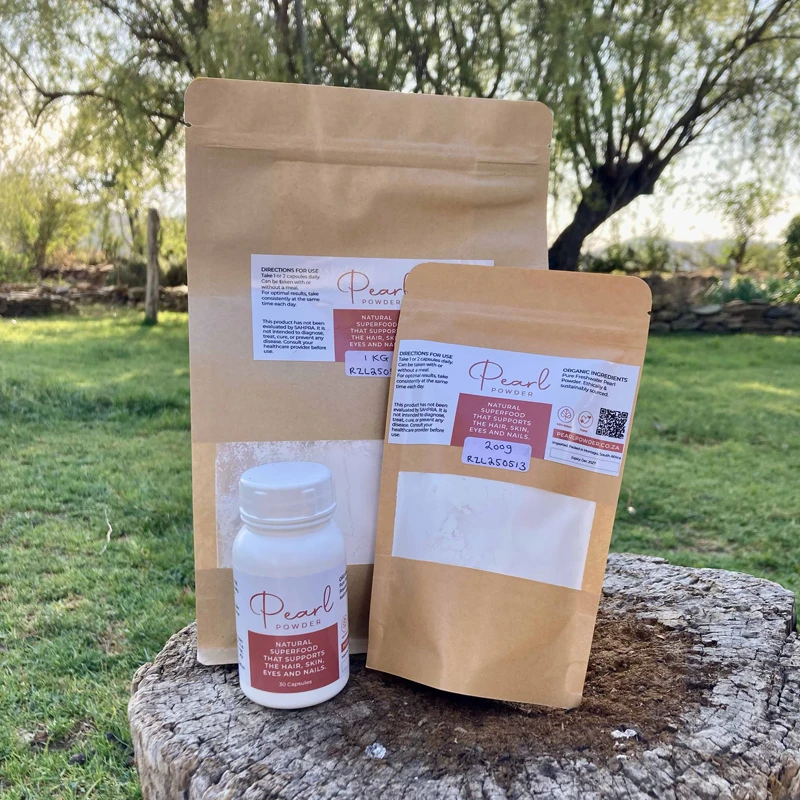
Pearl Powder is made from real freshwater pearls that are carefully cleaned, sterilised and milled into a very fine powder.
Pearls are naturally rich in calcium-based mineral compounds, trace minerals, amino acids and organic matrix proteins. This is what makes Pearl Powder so interesting as both a beauty ingredient and a mineral-rich superfood.
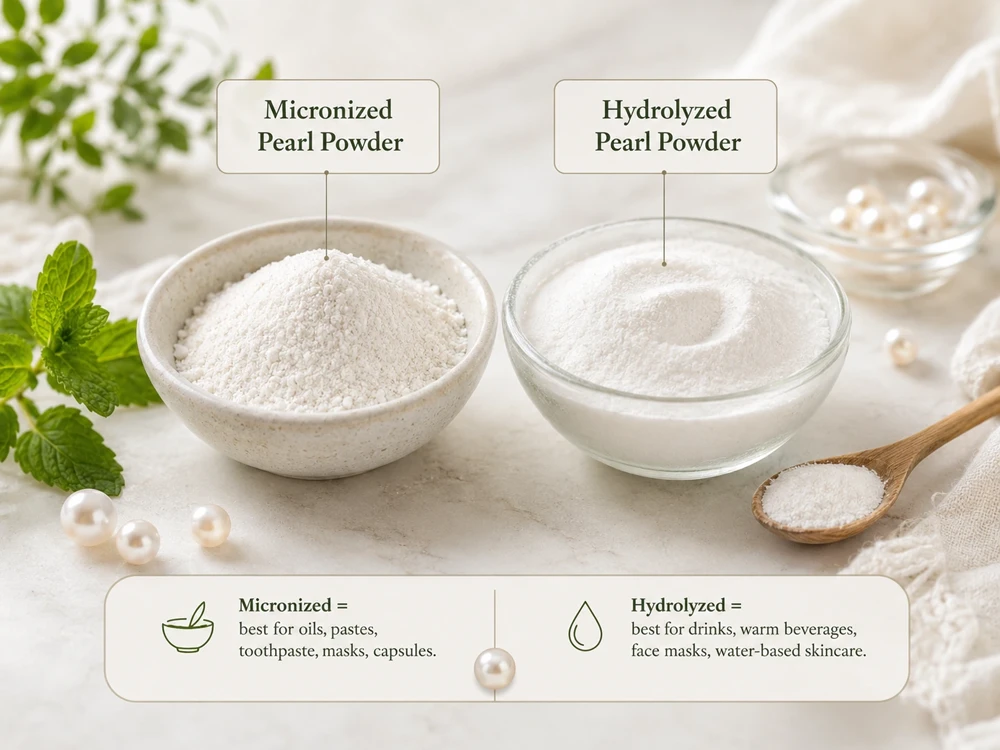
At LDJ Sacred Superfoods, Pearl Powder is available in two main forms:
Micronized Pearl Powder is an ultra-fine whole-pearl powder. It is not fully water-soluble, but it blends beautifully into oils, pastes, masks and capsules.
This is the best choice for:
Toothpaste
Oil pulling blends
Coconut oil preparations
Face masks
Traditional DIY beauty rituals
Hydrolyzed Pearl Powder has been processed to make it more water-soluble. It dissolves best in warm or hot water and is ideal for drinks and water-based skincare preparations.
This is the best choice for:
Tea, coffee, cacao and warm drinks
Smoothies
Water-based face masks
Facial washes
Moisturisers, lotions and serums
For toothpaste and oil pulling, we recommend Micronized Pearl Powder.
Micronized Pearl Powder blends better into coconut oil and pastes. It is the best choice for oil-based recipes, traditional DIY applications and natural oral care preparations.
Hydrolyzed Pearl Powder is better suited to drinks, warm beverages and water-based skincare recipes.
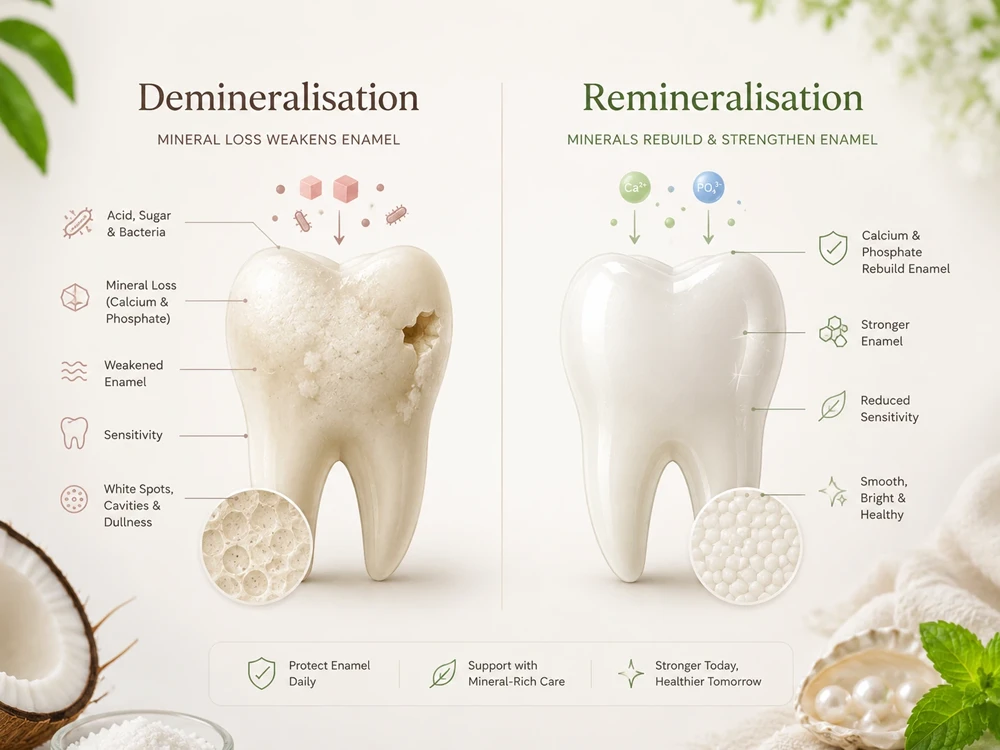
Teeth are highly mineralised structures, and the outer layer, known as enamel, is the hardest substance in the human body, but it is still vulnerable to acid, sugar, bacteria, harsh brushing and mineral loss.
When minerals are pulled out of the enamel, this is called demineralisation.
Over time, demineralisation can contribute to:
Weak enamel
Tooth sensitivity
White spot lesions
Cavities
Rough or dull-looking teeth
Increased staining
A greater risk of enamel damage
The opposite process is called remineralisation.
Remineralisation is the process where minerals such as calcium and phosphate are redeposited into the tooth surface. This is especially important in the early stages of enamel weakening.
Pearl Powder is naturally rich in calcium carbonate and trace minerals, making it a beautiful supportive ingredient in a mineral-rich oral care routine.
Pearl Powder is not a magic cure for cavities, and it should not replace professional dental care. But because of its natural mineral profile, it may be helpful as part of a broader oral care routine focused on:
Supporting enamel mineral balance
Gently polishing the teeth
Supporting a cleaner mouth feel
Supporting gum health
Reducing over-reliance on harsh whitening products
Adding natural calcium-rich minerals to oral care
Pearl Powder is mainly made up of calcium-based mineral compounds, along with trace minerals, amino acids and organic matter.
Its natural composition may include:
Calcium carbonate — the main mineral compound in pearls
Magnesium — an important mineral for the body
Trace minerals — including zinc, selenium, manganese and other minerals
Amino acids — the building blocks of proteins
Organic matrix proteins — including conchiolin, which gives pearls their unique structure and lustre
This is why Pearl Powder is so much more than just “ground pearl.” It is a complex natural material with both mineral and organic components.
For oral care, the most relevant aspect is its calcium-rich mineral profile and its gentle polishing texture.
This is one of the most important questions.
The honest answer is:
Pearl Powder may help support early-stage enamel remineralisation, but it cannot reverse advanced cavities or repair deep decay.
A cavity usually begins long before we see a visible hole in the tooth.
In the early stage, acids from bacteria, sugar and food begin to pull minerals out of the enamel. This can appear as a chalky white spot or weakened area on the tooth surface. At this stage, remineralisation may still be possible with the right oral care support.
Once a cavity has progressed into a physical hole or deeper decay, it usually needs professional dental treatment.
So, Pearl Powder is best understood as a supportive mineral ingredient, not a dental treatment.
A strong remineralising oral care routine may include:
Gentle brushing
A mineral-rich toothpaste
Hydroxyapatite
Good saliva flow
A low-sugar diet
Proper hydration
Regular flossing
Professional dental check-ups
Enough minerals in the diet
Pearl Powder may support this process as a natural calcium-rich ingredient, especially when paired with hydroxyapatite.
Pearl Powder may help support a brighter-looking smile in a gentle, natural way.
It does not bleach the teeth like peroxide-based whitening treatments. Instead, its effect is more of a gentle polishing action. The fine mineral powder may help lift surface stains and smooth the appearance of the enamel.
This is why Pearl Powder is often loved as a natural beauty ingredient: it works subtly, gently and gradually.
It may be especially helpful for those who want a more holistic approach to oral care and prefer to avoid very harsh whitening products.
That said, gentle is the key word. Even natural powders should be used mindfully. Avoid brushing too hard, and do not use abrasive ingredients aggressively or excessively.
Activated charcoal has become very popular in natural teeth-whitening products, mainly because it may help bind to impurities and lift surface stains.
However, charcoal can also be abrasive if used too often or too aggressively. Over time, harsh abrasion may contribute to enamel wear, sensitivity or roughness.
This is why we only use a very small amount of activated charcoal in our recipe.
In this formula, activated charcoal is not the main ingredient. It is included as a small supporting ingredient, while the main focus is on:
Coconut oil
Pearl Powder
Hydroxyapatite
Peppermint essential oil
Clove bud essential oil
Pearl Powder offers a softer, more mineral-rich approach, while the charcoal adds a very small stain-lifting element.
Hydroxyapatite is one of the most exciting ingredients in modern natural oral care.
It is a naturally occurring mineral form of calcium phosphate and is one of the main minerals that make up tooth enamel and dentin. In simple terms, hydroxyapatite is one of the building blocks of your teeth.
Because of this, hydroxyapatite is commonly used in remineralising toothpastes.
It can help support the tooth surface by filling in microscopic irregularities and encouraging a smoother, stronger enamel feel.
In oral care, hydroxyapatite is often used to support:
Enamel remineralisation
Tooth surface repair
Sensitivity support
A smoother enamel surface
Stronger-feeling teeth
Early enamel lesion support
This makes it a beautiful companion ingredient to Pearl Powder.
Pearl Powder brings natural calcium carbonate, trace minerals and traditional beauty wisdom. Hydroxyapatite brings a more targeted enamel-supportive mineral that closely resembles the mineral structure already present in teeth.
Together, they create a more complete remineralising toothpaste blend.
There are two main ways to use Pearl Powder for teeth:
Internally, as a mineral-rich supplement
Topically, as part of a toothpaste or oil-pulling blend
Taking Pearl Powder as a supplement can support your mineral intake, especially because Pearl Powder is naturally rich in calcium compounds and trace minerals.
Calcium is an important mineral for healthy teeth and bones. While oral hygiene happens in the mouth, mineral nourishment also matters from the inside out.
Pearl Powder can be mixed into:
Smoothies
Herbal teas
Warm cacao
Coffee
Yogurt
Water
Capsules
For internal use, Hydrolyzed Pearl Powder is the easiest to mix into warm drinks because it is water-soluble.
Micronized Pearl Powder can also be taken internally, but it may not fully dissolve and is often better in capsules, smoothies, yogurt or thicker drinks.
Pearl Powder can also be used topically as part of a natural oral care routine.
Because it is naturally rich in calcium compounds, it may help support the remineralisation of teeth while gently polishing the enamel for a brighter, healthier-looking smile.
Below is one of our favourite ways to use Pearl Powder for teeth, either as a natural toothpaste or as an oil-pulling blend.
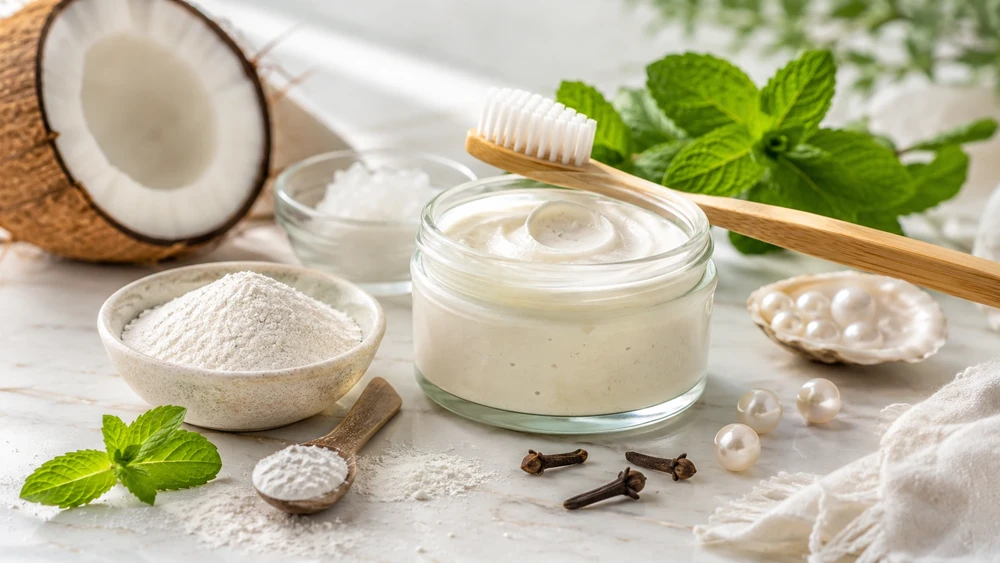
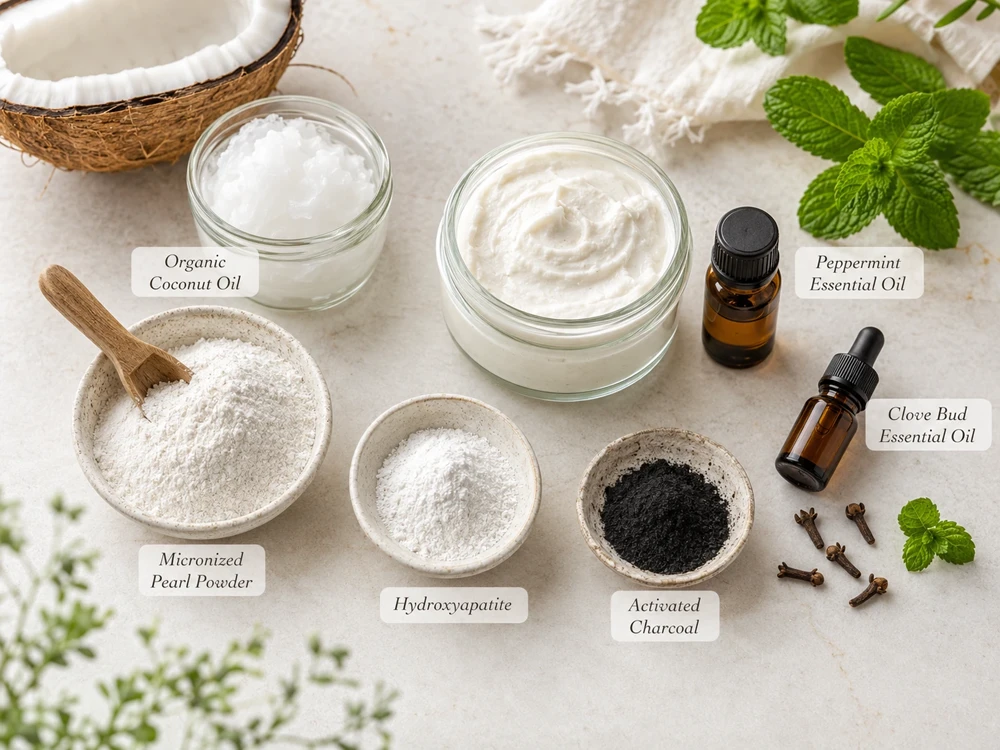
This is our formula for a mineral-rich, natural toothpaste blend.
4 tablespoons organic coconut oil
2 teaspoons Micronized Pearl Powder (also works with Hydrolized Pearl Powder)
2 teaspoons hydroxyapatite powder
¼ teaspoon activated charcoal
20–30 drops peppermint essential oil
8 drops clove bud essential oil
Add all the ingredients to a small, clean glass jar and mix well until it forms a smooth paste.
Store in a cool place. If the coconut oil becomes too firm, simply warm the jar slightly in your hands or place it somewhere warm until it softens again.
To use as toothpaste, apply a small amount to your toothbrush and brush gently.
As with any natural polishing ingredients, it is best not to brush too aggressively.
Use your own sensitivity as a guide. If your teeth or gums feel sensitive, use it less often or adjust the formula.
Pearl Powder
Pearl Powder is naturally rich in calcium carbonate and trace minerals.
Calcium is an important mineral for healthy teeth, and Pearl Powder may help support enamel remineralisation while gently polishing the surface of the teeth.
In traditional beauty practices, Pearl Powder has long been associated with brightness, smoothness and luminosity. In oral care, this translates beautifully into a gentle polishing ingredient for a cleaner, brighter-looking smile.
Organic Coconut Oil
Coconut oil gives the toothpaste a smooth, creamy texture and is also traditionally used for oil pulling.
Oil pulling is an ancient oral care practice where oil is gently swished around the mouth for several minutes before being spat out.
Coconut oil helps carry the other ingredients around the teeth and gums, leaving the mouth feeling fresh and clean.
Hydroxyapatite
Hydroxyapatite is a mineral form of calcium phosphate and one of the main minerals naturally found in tooth enamel.
In toothpaste, hydroxyapatite is used to help support enamel strength, remineralisation and a smoother tooth surface.
This is one of the key ingredients that makes this recipe more than just a natural whitening paste — it turns it into a true remineralising blend.
Activated Charcoal
Activated charcoal is often used in natural oral care because it may help bind to impurities and lift surface stains.
However, charcoal can be abrasive if overused. That is why this recipe uses only a small amount.
The goal is not to scrub the teeth black or aggressively whiten them. The goal is to add a gentle stain-lifting element to a broader mineral-rich formula.
Brush gently and avoid using too much pressure.
Peppermint Essential Oil
Peppermint essential oil gives the toothpaste a fresh, clean taste and helps leave the mouth feeling refreshed.
It also makes the blend feel more like a familiar toothpaste, which can be helpful when switching from conventional toothpaste to a natural alternative.
Clove Bud Essential Oil
Clove bud essential oil has a long history of traditional use in oral care.
It gives the blend a warm, spicy note and is often used in natural tooth and gum preparations.
Because clove bud essential oil is strong, only a small amount is needed. Do not overuse it, especially if your gums are sensitive.
Use a small amount on your toothbrush and brush gently.
Because this is a natural toothpaste without foaming agents, it will not behave like a conventional toothpaste. It will feel more oily and mineral-rich, and it will not foam in the same way.
Brush slowly and gently, allowing the minerals to move over the teeth and gums.
After brushing, rinse your mouth with warm water.
This same mixture can also be used as an oil-pulling blend.
Take a small amount into your mouth and gently swish it around for 5–10 minutes. Move it slowly through the teeth and around the gums.
When finished, spit it out and rinse your mouth with warm water.
It is best not to spit coconut oil into the sink, as it can harden and block the drain. Rather spit it into a tissue and throw it away, or spit it outside in an appropriate place.
Oil pulling should not replace brushing, flossing or dental care, but it can be a beautiful addition to a natural oral hygiene routine.
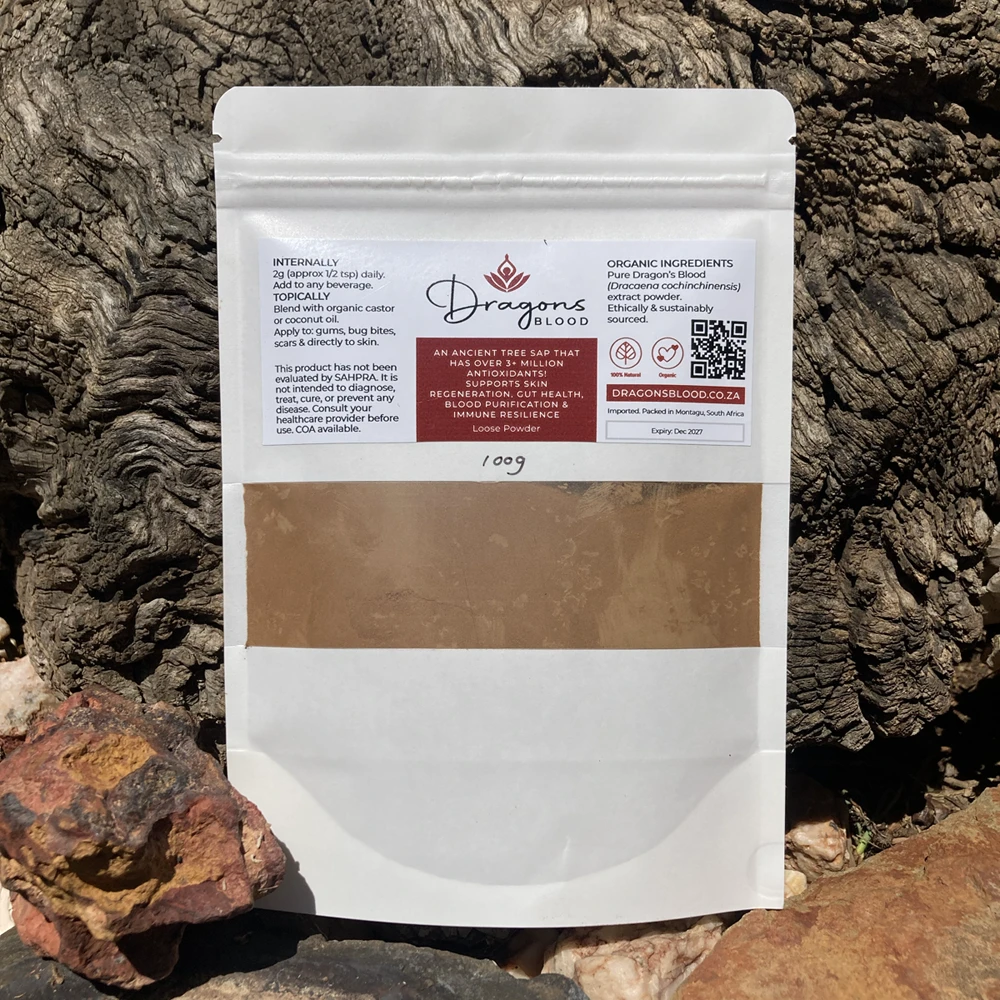
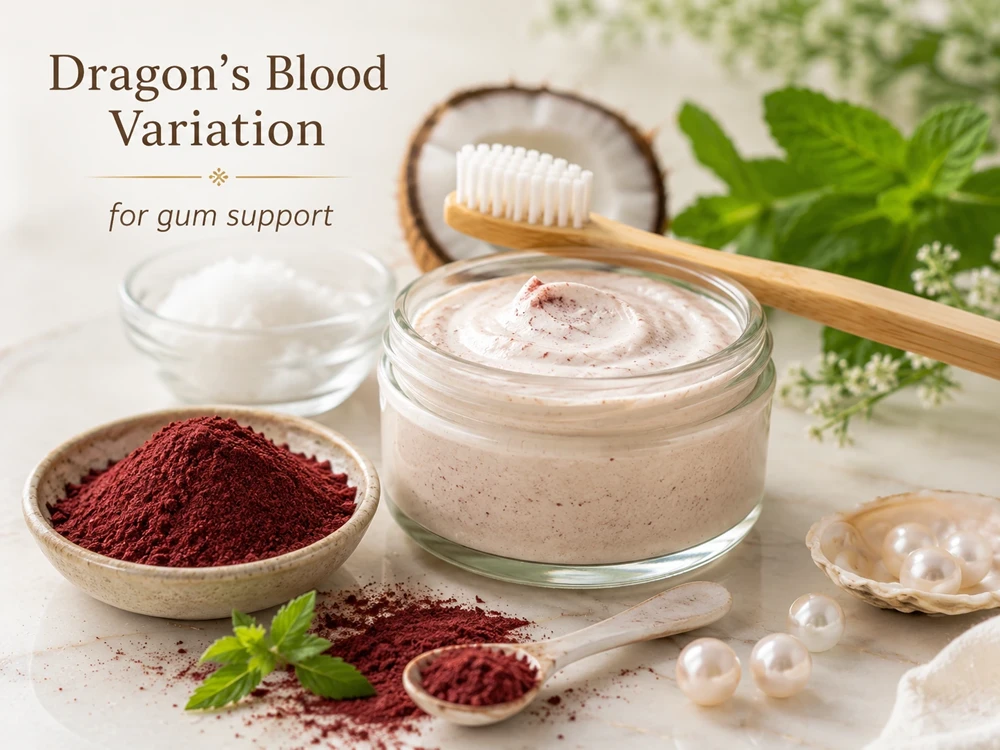
You can also make a variation of this toothpaste by adding a small amount of Dragon’s Blood powder.
Dragon’s Blood is traditionally valued for gum health and oral care. It may be a beautiful addition for those wanting a more herbal, gum-supportive version of this natural toothpaste.
To make this variation, simply add a small pinch of Dragon’s Blood powder to the recipe above and mix well.
This variation will change the colour and flavour of the toothpaste, giving it a deeper, more earthy and herbal feel.
Natural oral care can be a beautiful support, but it is not a replacement for professional dental care.
If you have cavities, gum disease, sensitivity, pain, loose teeth, bleeding gums, infections, dental restorations or any ongoing dental concern, please consult your dentist or oral health practitioner.
This article is for educational purposes only and is not intended to diagnose, treat, cure or prevent any disease.
Pearl Powder is one of those rare ingredients that feels both ancient and modern.
It carries the beauty of traditional wisdom, the symbolism of purity and luminosity, and a fascinating mineral profile that makes it especially interesting for natural oral care.
For teeth, Pearl Powder may offer gentle polishing, calcium-rich mineral support and a beautiful way to elevate your daily routine.
When combined with hydroxyapatite, coconut oil, peppermint, clove and a touch of activated charcoal, it becomes a deeply nourishing toothpaste and oil-pulling blend.
It is not about quick fixes or harsh whitening.
It is about tending to the mouth with care, minerals and consistency.
A brighter smile begins with a healthier foundation.
Is Pearl Powder good for teeth?
Pearl Powder may be a beautiful support for teeth because it is naturally rich in calcium compounds and trace minerals. It can be used as a gentle polishing ingredient and may support enamel remineralisation as part of a broader oral care routine.
Can Pearl Powder Reverse Cavities?
Pearl Powder cannot reverse advanced cavities or repair a hole in the tooth.
However, in the early stages of enamel weakening, when minerals have been lost but the tooth structure is still intact, remineralisation may be possible.
This is where mineral-rich oral care can be supportive.
Pearl Powder may support this process as a natural calcium-rich ingredient, especially when paired with hydroxyapatite.
For any pain, sensitivity, visible holes, dark spots, loose teeth, bleeding gums or ongoing dental concern, please consult your dentist.
Is Pearl Powder Safe for Daily Brushing?
Pearl Powder is generally considered gentle, especially compared to harsher abrasive whitening ingredients.
However, the full recipe also contains activated charcoal, so it is best to use the formula mindfully.
If your teeth and gums are healthy, you may enjoy using it regularly. If you have sensitivity, enamel erosion, gum recession or dental work, start slowly and see how your mouth responds.
The most important rule is:
Do not brush aggressively.
Let the minerals do the work. You do not need to scrub.
Can Pearl Powder help whiten teeth?
Pearl Powder may help gently polish the teeth and lift surface stains, giving the teeth a brighter, cleaner appearance. It does not bleach the teeth like peroxide whitening treatments.
Is Pearl Powder Better Than Charcoal for Whitening?
For a gentle, mineral-rich approach, Pearl Powder is my preferred ingredient.
Charcoal may help with surface stains, but it is more abrasive and should be used with care.
Pearl Powder has a softer feel and also brings calcium-rich mineral support, making it a more holistic ingredient for natural oral care.
In our formula, charcoal is used only in a tiny amount, while Pearl Powder and hydroxyapatite are the true stars of the recipe.
Is activated charcoal safe for teeth?
Activated charcoal should be used carefully because it can be abrasive if overused. This recipe uses only a small amount. Brush gently and avoid using too much pressure.
Can I Add Pearl Powder to My Regular Toothpaste?
Yes, you can sprinkle a small pinch of Pearl Powder onto your regular toothpaste for an added mineral boost.
This is an easy way to start using Pearl Powder for teeth if you are not ready to make your own toothpaste yet.
Which Pearl Powder Should I Use for Teeth?
For toothpaste and oil pulling, use Micronized Pearl Powder.
Micronized Pearl Powder blends better into coconut oil and pastes. It is ideal for traditional DIY recipes, topical applications and oil-based preparations.
Hydrolyzed Pearl Powder is better suited to drinks, warm beverages and water-based skincare recipes.
What is hydroxyapatite?
Hydroxyapatite is a mineral form of calcium phosphate and one of the main minerals naturally found in tooth enamel. It is used in remineralising toothpaste to support enamel strength and tooth surface repair.
Can I use this recipe for oil pulling?
Yes. This same mixture can be used as an oil-pulling blend. Swish gently for 5–10 minutes, then spit it out into a tissue or outside in an appropriate place. Do not spit coconut oil into the sink, as it may harden and block the drain.
Can I add Dragon’s Blood powder to the recipe?
Yes, you can add a small pinch of Dragon’s Blood powder for a more herbal, gum-supportive variation. It will change the colour and flavour of the toothpaste.
Where can I buy Pearl Powder and Dragon's Blood in South Africa?
You can order these products online from LDJ Sacred Superfoods.
This article is written for educational purposes and combines traditional use, personal experience, and emerging research in natural oral care. For readers who enjoy going deeper into the science behind Pearl Powder, hydroxyapatite, oil pulling, and activated charcoal, the following resources are helpful starting points.
Important note: Natural oral care can be a beautiful support, but it should not replace regular brushing, flossing, professional dental check-ups, or treatment from a dentist where needed.
We supply our Sacred Superfoods directly to customers, holistic practitioners, resellers, and those formulating their own beauty, skincare, and wellness products.
If you would like to buy in bulk, resell our products, create your own formulations, or need guidance, please reach out to us. We are happy to guide you toward the most suitable superfoods for your intended use.


Copyright © 2026 LDJ Ventures (Pty) Ltd | Website by LDJ